
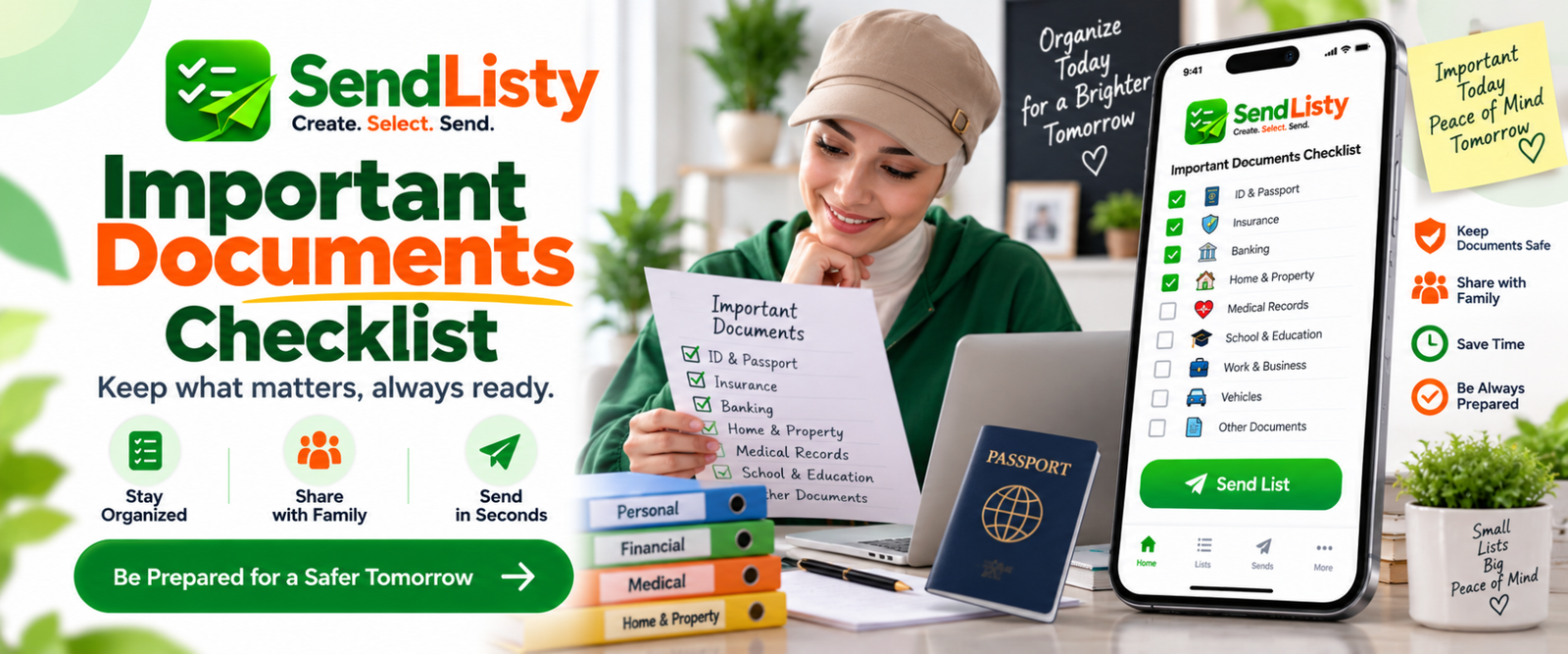
Important Documents Checklist: 53 Items
Organize essential household documents, from identification and property records to insurance and emergency contacts. Keep originals safe and store digital copies securely.
Read Full Guide
What is Send Listy?
Create and organize your own lists. Start here, add or remove items, check off what matters, and share selections via WhatsApp or iMessage.
Make this checklist your own. Add what you need, edit what you like, and remove anything that doesn’t fit.
🪪 Identity & Civil Records
Notes: Keep current identification details and store originals securely.
Keep current identification details and store originals securely.
Notes: Include this document only if relevant to your household.
Include this document only if relevant to your household.
Notes: Include relevant divorce decrees or name-change orders.
Include relevant divorce decrees or name-change orders.
Notes: Include relevant citizenship or immigration documents as applicable.
Include relevant citizenship or immigration documents as applicable.
👨👩👧👦 Family & Education
Notes: Keep documents relevant to your household’s legal situation.
Keep documents relevant to your household’s legal situation.
Notes: Keep important transcripts or diplomas required for future use.
Keep important transcripts or diplomas required for future use.
🏠 Home & Property
Notes: Store permits and applicable warranties for major work.
Store permits and applicable warranties for major work.
Notes: Keep photos or other evidence useful for insurance claims.
Keep photos or other evidence useful for insurance claims.
🚗 Vehicles
🛡️ Insurance
Notes: Include the policy if it applies to your family.
Include the policy if it applies to your family.
🏦 Financial
Notes: List institutions and safe contact details without recording passwords.
List institutions and safe contact details without recording passwords.
🧾 Tax
⚖️ Medical & Legal
🔐 Backup & Security
Notes: Store essential contact details or copies separately where appropriate.
Store essential contact details or copies separately where appropriate.
Notes: Tell an authorized person how to locate critical records.
Tell an authorized person how to locate critical records.
Notes: Check which records need updating at least once per year.
Check which records need updating at least once per year.
Complete Guide
Complete guide to organizing important household documents
Important documents are most useful when you can locate the correct version quickly and keep private information protected. This checklist helps you review identity records, housing papers, financial accounts, insurance details, health documents and emergency contacts without mixing every paper into one drawer.
It is not a recommendation to upload sensitive records to Send Listy. Use the checklist to track what needs organizing; keep actual scans, passwords and account numbers in storage designed for confidential information.
Sort documents by purpose, not by random piles
Create categories you can recognize when you are in a hurry: identification and civil records, home and vehicle, banking and taxes, insurance and health, education and employment, and emergency information. Label folders clearly and store originals where the right household member can find them.
Choose categories suited to your country and household. A document required in one jurisdiction may not apply elsewhere, and a digital certificate may replace paper in some services.
Separate originals, working copies and reference details
Vital originals often need a secure location protected from loss, fire or casual access. Everyday working copies should be clearly distinguished so someone does not accidentally use an outdated document. Keep a simple record of where the original is stored, not an exposed copy of its identifying numbers.
For emergencies, having access to a limited set of necessary records or a protected backup may help with recovery. State emergency-management resources recommend planning for access to critical documents before a disaster occurs.
Build secure digital backups
When scanning is permitted, use clear filenames that include a useful type and year but not excessive personal information. Check whether the entire page is legible, including important dates. Store copies with appropriate access control and consider an encrypted backup and account recovery plan.
Avoid sending scans through public links or casual group chats. Do not put passport numbers, passwords or bank account details in checklist notes. A list of document categories is safer to share than the documents themselves.
Review retention and safe disposal
Not every receipt or statement has to be kept permanently. Retention periods depend on document type, tax rules, legal obligations and your location. Before discarding a record, check whether it is needed for an active dispute, warranty, property matter or official filing.
The U.S. Federal Trade Commission offers examples of records to keep and sensitive papers to shred. Treat its retention suggestions as U.S.-focused reference material, not universal law. Shred or securely destroy unneeded records containing personal data.
Prepare an emergency access plan
A household emergency plan should identify an appropriate contact, where critical originals are stored and how to access protected copies when needed. Consider identification, insurance contacts, household contact lists and relevant medical information, while respecting privacy and consent.
Do not give broad access to every file merely because someone is trusted. Decide who genuinely needs which information, and use secure methods to share it.
Review changes and keep the system current
A scheduled review can catch expired IDs, renewed policies, changes of address and obsolete copies. Update the location of an original if it moves and remove duplicate drafts that might cause confusion.
Customize this Send Listy checklist so it reflects only the records your household uses. Revisit after moving, changing employment, major purchases or other events that alter your paperwork.
For a related routine, see the monthly bills checklist.
Frequently asked questions
What documents should I organize first?
Prioritize identification, key civil records, housing and insurance papers, financial obligations, health-related records and emergency contacts relevant to your household.
Should I keep originals and copies together?
Usually it is easier to distinguish the secure location of originals from everyday reference copies. Follow the issuing authority’s rules for documents that must be original.
Can I save document numbers in Send Listy notes?
Avoid placing passport numbers, passwords, banking credentials and other sensitive information in checklist notes. Use secure storage for confidential records.
How long must I keep tax or financial documents?
Retention rules vary by country and document type. Verify current requirements with the relevant tax authority or a qualified professional before destroying records.
Are digital backups enough?
Not always. Some organizations require originals, and electronic access may fail during an emergency. Check local requirements and maintain appropriately protected backups.
How often should I review my document folders?
Review them periodically and after major life changes, renewals or a change of address so the index stays accurate.
Suggested Sources
More than just a checklist
Ready to organize your way? Add this checklist to Send Listy and make it yours.
Use this checklist in Send Listy